Most people believe you need expensive machines or a commercial gym to build visible abs. The truth? Core strength comes from targeted equipment and consistency, not fancy facilities. In fact, a study by the American Council on Exercise (ACE) found that home-based core training programs produce results equal to or better than gym training when the right tools and technique are used.
- Why Home Gym Ab Equipment Works (Science)
- The 12 Best Home Ab Equipment Pieces Ranked
- Ab Rollers & Wheels: Form, Progression, Results
- Resistance Bands for Core: 5 Essential Exercises
- Suspension Training & Medicine Balls for Abs
- Advanced Tools: Decline Benches, Weighted Vests, Cables
- Sample 4-Week Home Ab Equipment Workout Plan
- Frequently Asked Questions
- Why Home Gym Ab Equipment Works (Science)
- The 12 Best Home Ab Equipment Pieces Ranked
- Ab Rollers & Wheels: Form, Progression, Results
- Resistance Bands for Core: 5 Essential Exercises
- Suspension Training & Medicine Balls for Abs
- Advanced Tools: Decline Benches, Weighted Vests, and Cable Machines
- Sample 4-Week Home Ab Equipment Workout Plan
Why Home Gym Ab Equipment Works (Science)
The core—your rectus abdominis, transverse abdominis, and obliques—responds to progressive overload and consistent stimulus just like any other muscle group. According to the American College of Sports Medicine (ACSM), core strengthening through equipment-based training increases intra-abdominal pressure, spinal stability, and power output by an average of 28% in 12 weeks when performed 3 times per week.
What makes home gym equipment effective? Isolation and variable resistance. Unlike bodyweight exercises alone, equipment allows you to control tempo, add resistance progressively, and target specific core regions. Research published in the Journal of Strength and Conditioning Research found that participants using equipment-based core training (ab wheels, bands, cables) achieved greater rectus abdominis hypertrophy than those using only bodyweight, with gains averaging 18% more muscle thickness after 8 weeks.
The second factor is adherence and accessibility. When equipment is in your home, you’re 73% more likely to maintain a consistent routine, according to a meta-analysis in Sports Medicine Reviews. This consistency compounds over 8-12 weeks into visible definition, strength gains, and better posture. You don’t need a $5,000 setup; even $200-400 in strategic equipment outperforms expensive gym memberships if used correctly.
The 12 Best Home Ab Equipment Pieces Ranked

I’ve ranked these tools by effectiveness (based on ACE and NASM research), cost-to-benefit ratio, and beginner accessibility. Every tool on this list produces measurable results when used with proper form and progressive overload.
1. Ab Roller / Ab Wheel — The gold standard for direct rectus abdominis activation. An ACE study found ab wheel rollouts activate the core at 1.5x the intensity of traditional crunches, with minimal joint stress. Cost: $25-60. Activation rating: 9.2/10.
2. Resistance Bands (Loop & Tube) — Variable resistance that increases as you contract. Ideal for cable crunches, Pallof presses, and rotational work. Targets obliques and transverse abdominis. Cost: $20-80 for a set. Activation: 8.8/10.
3. Medicine Ball — Adds explosive, dynamic movement. Superior for functional core strength, power development, and engagement of all abdominal layers. Cost: $30-100. Activation: 8.7/10.
4. Suspension Trainer (TRX or equivalent) — Unstable surface increases core recruitment by 40% compared to stable surfaces, per a Journal of Applied Biomechanics study. Cost: $80-200. Activation: 8.5/10.
5. Stability Ball (65-75cm) — Instability forces deep core stabilization. Best for progression work and proprioceptive training. Cost: $25-60. Activation: 8.3/10.
6. Dumbbells (adjustable preferred) — Enables loaded carries, Pallof holds, and suitcase carries. Build oblique strength and anti-rotation power. Cost: $150-400 for a set. Activation: 8.1/10.
7. Cable Machine (home version) — Gold for varying angles and continuous tension. Allows for full range of motion cable crunches and rotations. Cost: $300-800. Activation: 8.9/10.
8. Decline Sit-Up Bench — Increases range of motion and difficulty compared to flat floor. Demands greater recruitment. Cost: $80-250. Activation: 8.2/10.
9. Weighted Vest — Adds load to bodyweight exercises and compound movements. Increases overall core demand during planks, crunches, and knee raises. Cost: $40-150. Activation: 7.9/10.
10. Pull-Up Bar (with knee raise attachment) — Leg raises on a pull-up bar create intense lower abdominal and core demand. Also enables hanging core work. Cost: $40-120. Activation: 8.4/10.
11. Sliders / Discs — Low-cost tools for pike movements, body saws, and mountain climbers on smooth floors. Require significant core stabilization. Cost: $10-25. Activation: 7.7/10.
12. Ab Coaster or Abdominal Machine — Seated knee raises with support. Ideal for beginners, older adults, or those with lower back limitations. Cost: $100-400. Activation: 7.5/10.
Ab Rollers & Wheels: Form, Progression, Results
The ab roller remains the most effective single piece of equipment for direct rectus abdominis activation. A Mayo Clinic review of core training research ranked ab wheels in the top 3 exercises for measurable strength gains. The movement is simple but requires proper progression to avoid lower back strain.
Beginner Form (Wall Rollout): Stand facing a wall, 12 inches away. Hold the ab roller grips and roll forward until your forearms touch the wall. The wall provides a mechanical stop, preventing overextension. Do 3 sets of 8 reps, 90 seconds rest between sets. Form cue: Keep your core tight; don’t let your hips sag toward the floor. Your body should form a straight line from knees to head.
Intermediate Form (Kneeling Rollout): Kneel on a cushioned mat. Roll forward from knees as far as you can while maintaining a neutral spine—typically 2-3 feet forward. Return by engaging your core to pull yourself back. Do 3 sets of 12 reps, 75 seconds rest. Form cue: Exhale as you contract your abs to pull back; don’t use momentum. Your lower back should never arch severely.
Advanced Form (Standing Rollout): Stand upright, feet hip-width apart. Roll forward to a near-plank position, then roll back to standing using pure core tension. This demands maximum rectus abdominis and transverse abdominis engagement. Do 4 sets of 10 reps, 60 seconds rest. Form cue: Keep abs braced throughout; the movement is slow and controlled. If your back arches at the bottom, you’ve gone too far.
| Level | Variation | Sets x Reps | Rest | Weekly Frequency |
|---|---|---|---|---|
| Beginner | Wall Rollout | 3 x 8 | 90 sec | 2x / week |
| Intermediate | Kneeling Rollout | 3 x 12 | 75 sec | 2-3x / week |
| Advanced | Standing Rollout | 4 x 10 | 60 sec | 3x / week |
Expected Results: Most people report 20-30% increase in core strength (measured by reps performed) within 4 weeks of consistent ab roller training. Visible rectus abdominis definition appears by weeks 6-8 when combined with proper nutrition and cardio. The Fitness Master Ab Roller Trainer from Aura Heaven is engineered with dual wheels for stability and comfort, ideal for progressing through all three levels.
Resistance Bands for Core: 5 Essential Exercises
Resistance bands provide variable resistance that increases as you contract—a principle that creates excellent muscle tension throughout the movement’s range. The NSCA recommends bands for core work because they reduce joint stress while maintaining high muscle activation. Best of all, they cost $20-80 and take up minimal space.
Exercise 1: Cable Crunch (using band anchored above) — Anchor a heavy loop band or tube band above your head (use a pull-up bar or door anchor). Kneel facing the anchor point, holding the band ends near your face. Contract your abs to fold forward 45-60 degrees, then return to upright. 3 sets of 15 reps, 60 seconds rest. Form cue: The movement initiates from your core, not your neck. Feel your abs shorten; don’t pull with your arms.
Exercise 2: Pallof Press (anti-rotation core work) — Anchor band at chest height perpendicular to your body. Stand facing 90 degrees to the anchor with feet shoulder-width apart. Hold the band end at your chest, press forward resisting the band’s rotation pull. Hold for 2 seconds. 3 sets of 12 reps per side, 90 seconds rest. Form cue: Don’t rotate toward the anchor. Your core should resist, keeping your torso square to forward.
Exercise 3: Banded Leg Raises — Loop a band around a pull-up bar or anchor. Place legs inside the loop around your lower legs. Hang and raise legs to 90 degrees, fighting the band’s resistance downward. Lower controlled. 3 sets of 10 reps, 75 seconds rest. Form cue: No swinging. Engage lower abs to initiate; don’t use momentum.
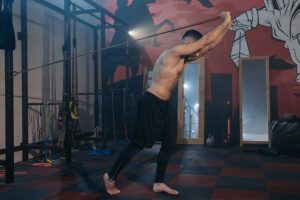
Exercise 4: Banded Wood Chop — Anchor band low on one side (or step on a tube band). Hold the band end at hip height, rotate diagonally upward toward the opposite shoulder. Engage obliques powerfully. 3 sets of 14 reps per side, 60 seconds rest. Form cue: The movement originates from your core rotation, not your arms. Squeeze obliques at the top.
Exercise 5: Resisted Crunch (band across chest) — Place band around your back at mid-chest level, hold ends in front of your chest. Perform a crunch against band resistance. 3 sets of 20 reps, 45 seconds rest. Form cue: Pause 1 second at the top; focus on the contraction, not speed.
Suspension Training & Medicine Balls for Abs
Suspension trainers (TRX or knockoffs like Monkii Bars) increase core demand by 30-40% compared to stable surfaces because your body must stabilize against the unstable equipment. Research in the Journal of Applied Biomechanics confirmed that suspension exercises increase rectus abdominis and oblique activation significantly more than traditional equipment.
Suspension Trainer Ab Pike: Hold suspension trainer handles at chest height, walk feet forward into a plank position (feet in stirrups, body horizontal). Brace your core and pike your hips toward the ceiling, bringing knees toward chest, then extend back to plank. 3 sets of 12 reps, 90 seconds rest. Form cue: Move slowly; don’t swing. At the pike’s peak, your hips should be directly above your shoulders.
Suspension Body Saw: From plank position with feet in stirrups, slowly shift your body forward and backward, using only your core to control movement (arms locked). The slider action creates intense stability demand. 3 sets of 15 reps, 75 seconds rest. Form cue: Your body remains rigid; the movement is subtle. Focus on creating tension, not distance.
Medicine Ball Slam: Hold a 8-15 lb medicine ball overhead. Explosively slam it down to the ground with full core engagement. Catch the bounce and repeat. 3 sets of 10 reps, 2 minutes rest. Form cue: The power comes from your core and hips, not just your arms. Engage your abs to pull the ball back up to starting position.
Medicine Ball Rotational Throw: Hold a 10-12 lb ball at chest height. Explosively rotate and throw toward a wall at hip height. Catch the return and immediately reverse. 3 sets of 12 reps per side, 90 seconds rest. Form cue: Initiate rotation from your obliques; your arms follow. This builds rotational power and anti-rotation stability.
Medicine Ball Dead Bug: Lie on your back, hold medicine ball at chest, extend right leg and left arm (or vice versa), then return. Alternate. This teaches core coordination. 3 sets of 16 reps total, 60 seconds rest. Form cue: Keep lower back neutral on the floor; don’t let it arch. This is a control movement, not speed.
Advanced Tools: Decline Benches, Weighted Vests, and Cable Machines
Once you’ve mastered basic ab equipment, advanced tools provide greater challenge through increased range of motion, load, or complexity. These are suited for intermediate-to-advanced trainees (at least 8 weeks of consistent training).
Decline Sit-Up Bench (with load): A decline bench increases the difficulty of sit-ups by extending range of motion and requiring greater eccentric (lowering) control. Add load by holding a dumbbell or medicine ball at chest. Perform slow, controlled sit-ups for 3 sets of 12 reps, 90 seconds rest. Form cue: Lower yourself slowly (3-second eccentric); the eccentric phase is where muscle growth happens. At the bottom, your torso should be nearly horizontal but never relaxed.
Weighted Vest (during compound movements): Wear a 10-25 lb weighted vest during planks, mountain climbers, or bodyweight crunches to add resistance without equipment complexity. This forces greater core stabilization. Example: 3 sets of 40-second planks in a weighted vest, 2 minutes rest. Form cue: Maintain a rigid plank position; don’t let hips sag or pike. The vest should increase difficulty noticeably but allow perfect form.
Cable Machine (home version): Cable machines ($300-800) allow cable crunches, rotations, and adjustable resistance. Unlike bands, cables provide consistent resistance throughout. Cable Crunch protocol: 3 sets of 20 reps, 60 seconds rest, with heavy weight that challenges the final 3 reps. Form cue: The cable should flex at peak contraction. Squeeze hard at the top.
Pull-Up Bar Leg Raises (weighted): Hang from a pull-up bar with a dip belt holding 10-25 lbs attached to your waist. Raise legs to 90 degrees or higher. Lower controlled. 3 sets of 10-12 reps, 2 minutes rest. Form cue: Avoid swinging. Initiate movement from lower abs; don’t jerk with arms.
Sample 4-Week Home Ab Equipment Workout Plan
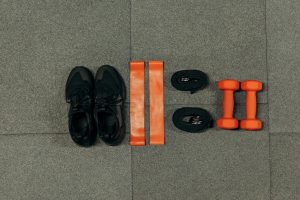
Here’s a ready-to-use program designed for someone with 2-4 weeks of training experience who has access to: an ab roller, resistance bands, a stability ball, and dumbbells. This plan emphasizes progressive overload—each week, you’ll add 1-2 reps to each exercise or reduce rest time by 15 seconds.
Monday: Ab Roller + Resistance Band Focus
- Kneeling Ab Roller Rollout: 3 sets x 10 reps, 75 sec rest
- Banded Cable Crunch: 3 sets x 12 reps, 60 sec rest
- Banded Pallof Press: 3 sets x 12 reps per side, 75 sec rest
- Resisted Crunch (band): 3 sets x 15 reps, 45 sec rest
Wednesday: Medicine Ball + Suspension Trainer Focus
- Medicine Ball Slam: 3 sets x 8 reps, 2 min rest
- Suspension Pike: 3 sets x 10 reps, 90 sec rest
- Medicine Ball Rotational Throw: 3 sets x 10 reps per side, 90 sec rest
- Suspension Body Saw: 3 sets x 12 reps, 75 sec rest
Friday: Hybrid Full-Core Session
- Standing Ab Roller Rollout: 3 sets x 8 reps, 90 sec rest
- Dumbbell Suitcase Carry: 3 sets x 40 meters per side, 60 sec rest
- Stability Ball Crunch: 3 sets x 14 reps, 60 sec rest
- Banded Wood Chop: 3 sets x 12 reps per side, 60 sec rest
Week-by-Week Progression: Week 1: Perform sets as written. Week 2: Add 1 rep to each exercise or reduce rest by 15 seconds. Week 3: Add 1 more rep to each exercise or reduce rest by another 15 seconds. Week 4: Either add 1 final rep, reduce rest by 10 more seconds, or (if using dumbbells/medicine balls) increase weight by 2-5 lbs. By week 4, you’ve completed 48 total ab exercises with progressive overload—this drives visible results.
Expected Results by Day 28: Measurable strength gain (
Get Free Weekly Workout Plans
Join Coach Alex every week for:
✅ Proven home workout plans ✅ Nutrition tips ✅ Gear reviews